PDFs are where structured workflows stall
Blood-test results often arrive as documents first, leaving teams to bridge the gap between a PDF and a usable operational record.
Upload blood-test PDFs, review extracted biomarkers, and deliver approved results as CSV, JSON, or API output. Built for clinics, longevity practices, and health products.
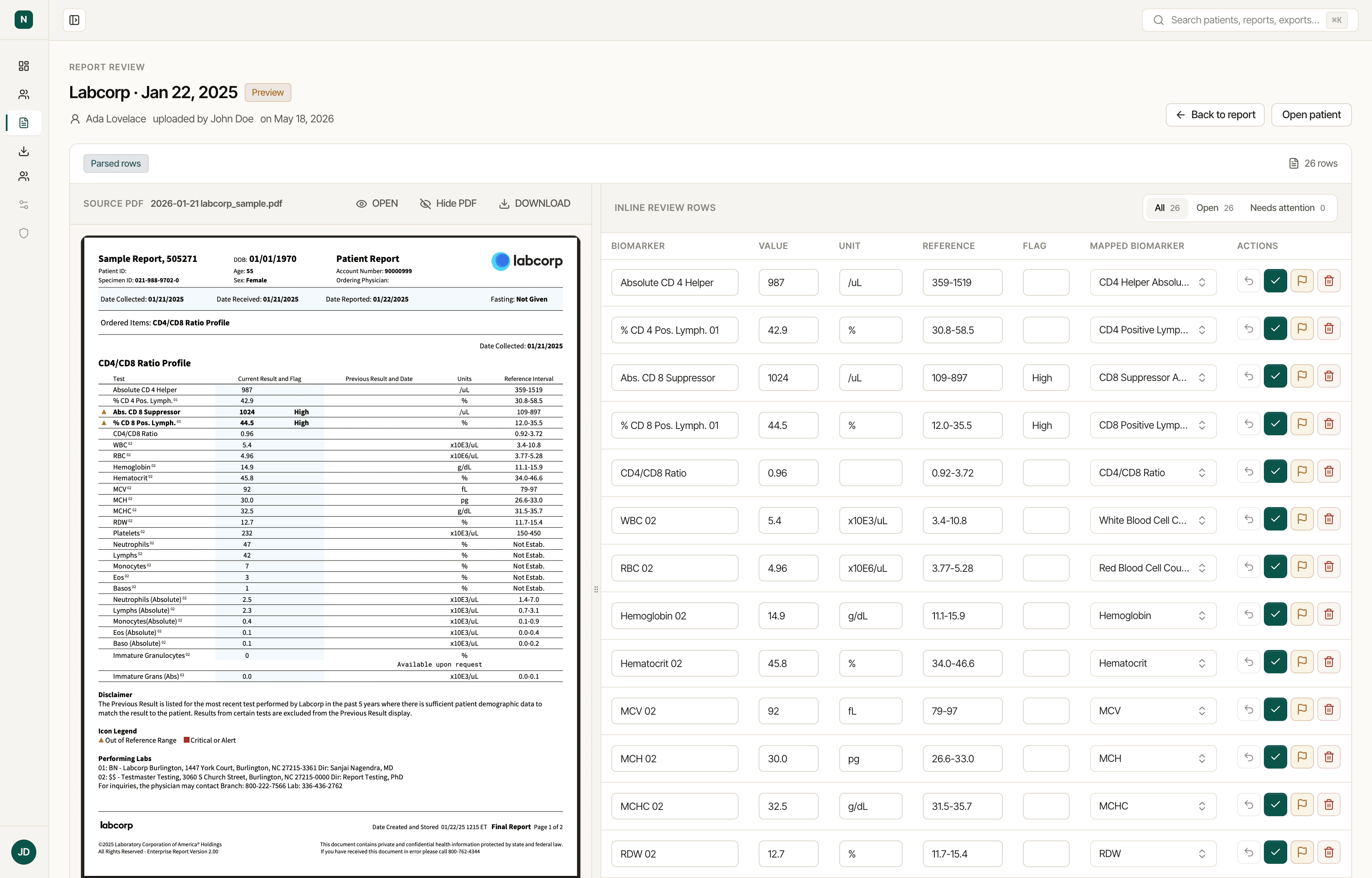
The problem is not getting a document. The problem is turning that document into reviewed, structured biomarker data your team can actually use.
Blood-test results often arrive as documents first, leaving teams to bridge the gap between a PDF and a usable operational record.
Re-keying biomarkers, units, and ranges adds latency, creates avoidable mistakes, and turns reviewers into transcription staff.
Spreadsheets, internal tools, and health products need structured results with reviewer confidence behind every exported row.
Upload, extract, review, and deliver. The workflow stays operational from the first PDF to the final export.
Teams can upload blood-test PDFs manually today or send them through an integration path as part of their intake flow.
Each result is extracted into a consistent schema with the original label, value, unit, range, and the source report date.
Reviewers compare extracted biomarkers to the source PDF, correct anything uncertain, and approve the reviewed set.
Once approved, the data is ready for CSV, JSON, or API delivery into the systems your team or product already depends on.
The product is built around operational work: what needs review now, what changed, and what is ready to go downstream.
This is where extracted data becomes trusted operational data: compare rows against the source PDF, correct uncertainty, and approve the reviewed set before it moves downstream.
Keep the source report in view while you validate extracted rows.
Fix mapped biomarkers, values, and units before approval.
Only the reviewed result set is eligible for downstream delivery.
Open to the work that needs attention now instead of a generic landing page.
Route reviewed results onward in the format and scope your downstream system expects.
Operationalize external blood-test PDFs without routing everything through manual re-entry or a brittle spreadsheet handoff.
Scale premium preventative-health workflows while preserving reviewer oversight on the biomarker data patients actually see.
Add reviewed blood-test PDF ingestion and API delivery to your product instead of building the full review workflow in-house.
Move from incoming PDF to structured result set without turning clinicians or ops staff into data-entry operators.
Approval happens after review, so your exported data reflects a workflow your team can actually trust.
Deliver a clean, predictable format to spreadsheets, internal tools, or product integrations downstream.
Use organization-aware access and member controls so work stays scoped to the right workspace and team.
The landing page promise is simple: give teams structure, review gates, and traceability from the first workspace onward.
Need the buyer-facing version? Read the full security overview.
Each workspace is isolated for the team operating those reports, members, and exports.
Reviewed results are approved before export so the workflow has a clear operational checkpoint.
Invites, report actions, review events, and export transitions can be surfaced through a durable activity stream.
Workspace owners can invite teammates, control access, and keep sensitive health-data work inside a defined boundary.
Use the workspace to review and approve blood-test PDFs, then deliver structured results into your app through API output. That gives product teams a practical path to ingestion without rebuilding the reviewer workflow first.
{
  "patient": "WA-10421",
  "report_date": "2026-04-22",
  "status": "approved",
  "biomarkers": [
    {
      "name": "glucose_fasting",
      "value": 103,
      "unit": "mg/dL"
    },
    {
      "name": "vitamin_d_25oh",
      "value": 24,
      "unit": "ng/mL"
    }
  ]
}No. Test2Sheet Enterprise is a review layer for blood-test PDF ingestion. It helps teams turn reports into reviewed structured data, then export that data into the systems they already use.
Yes. The review workflow is designed for a human to confirm the extracted result set, adjust values or units when needed, and approve the reviewed data before it is exported.
The product story is centered on CSV, JSON, and API delivery so approved data can move into operational spreadsheets, internal tools, or health-product workflows.
No. Clinics are a strong fit, but the same workflow also applies to longevity practices and software teams that need reviewed blood-test PDF ingestion in their product.
The intended model is straightforward: reports enter the review workflow, a reviewer approves the extracted results, and your product receives the approved structured output through API delivery.